
How Effective is Methylprednisolone Pulse Therapy for Treating Hair Loss?

Alopecia areata universalisAlopecia areata, which is an autoimmune disorder, results in hair loss in round patches, or on the entire scalp, or even on the entire body. It affects 1%-2% of the population. If hair growth is desired, strong drugs such as steroidal injections and topical corticosteroids can help. However, these drugs can have unwanted side effects and can become less effective over time.

People with severe alopecia areata have had varying amounts of success with methylprednisolone pulse therapy.

One study1 researched the effectiveness of the therapy, and how long the effects last. Researchers injected an effective dose of methylprednisolone into patients with severe alopecia areata.

The patients were in one of two categories: some had alopecia totalis or universalis (hair loss on the scalp), and the rest had actively progressive multifocal alopecia (hair loss throughout the body).

The researchers found that Methylprednisolone pulse therapy was well-tolerated with no side effects. The therapy was effective for about 3 months for patients with alopecia totalis or universalis. Additionally, patients with multifocal alopecia had results for about 6 months after their treatments.

Another study2 questioned whether Methylprednisolone pulse therapy is an effective treatment for alopecia areata. This study found also found that the therapy was not very effective in patients with alopecia totalis or universalis (hair loss on the scalp). Some had hair growth and improvement in their condition; some did not have any results; and some had a delayed response 9-16 months after the therapy. The therapy was found to be most effective on patients with multifocal alopecia areata, with half or all of the hair follicles growing hair for at least 3 months, and sometimes for 12 months or more. The therapy can be re-applied for additional results.

“People with hair loss should consult a professional for a firm diagnosis,” said Dr. Shapiro, a dermatologist and hair transplant specialist in south Florida. “Several conditions can cause spot baldness, including alopecia areata, fungus and traction alopecia (constant pulling). I can diagnose and treat most of these conditions.”

Sources:
1. Guideline for Methylprednisolone Pulse Therapy of Alopecia Areata, Im et. al European Hair Research Society conference 2005.
2. Pulse methylprednisolone therapy for severe alopecia areata: An open prospective study of 45 patients. Friedli et. al. Journal of the American Academy of Dermatology
Hair Loss is a Pain – Trichodynia

blowing air can cause scalp pain in some people with hair lossA small percentage of people who experience hair loss also experience spontaneous pain in the scalp. Brushing or air blowing the scalp can also cause pain. This is called “Trichodynia.”

A study in Israel compared touch and pressure pain on the scalps of people experiencing hair loss with healthy controls.

In the people experiencing hair loss, the researchers concluded that pain was more significant in the areas of the scalp that had hair loss, mainly in the upper front and sides. The areas that were not painful were not affected by hair loss (mostly the back of the scalp). The balding sections also had a lower pain threshold than the non-balding parts. Also, the scalps of balding people had a lower pain threshold than the same regions of healthy controls.

There was no difference in the threshold for touch between balding areas and areas without hair loss.

This research suggests an association between hair loss and regional changes in the pain system. Since the pain threshold in the entire scalp regions of people with hair loss was lower than the controls’ may mean that people with hair loss have a generalized hypersensitivity of nociceptors (hyperalgesia).

Source: Pain Threshold in Patients with Hair Loss

Natural Eucalyptus Extract and Hair Health

Eucalyptus treeApplying a mild extract of natural eucalyptus to the scalp has been shown to improve the luster, appearance, elasticity, manageability and bounce of hair. Eucalyptus extract is made from the leaves of the eucalyptus tree, native to Australia. Eucalyptus has a camphor-like scent and is known as a disinfectant, purifier and cleanser, toner and astringent. 
How does eucalyptus extract improve hair health? A scientific study was conducted with ten healthy subjects. The study participants applied a lotion to half of their scalp that contained a 3% eucalyptus extract. On the other half of the scalp, they applied a lotion that was identical except it contained no eucalyptus. Before the study started, anagen hairs were taken from both sides of the scalp. After the three-week study, hairs were plucked again.

The scientists analyzed the transcriptional profiles of the hair root cells using DNA microarray hybridization and quantitative RT-PCR. The study also looked at human cultured keratinocytes and dermal papilla cells to discover the possible genes responsible for improving hair properties.

In the hair root cells that were treated with Eucalyptus extract, genes related to the structural components of the hair (i.e., filaggrin, epiplakin1,  desmoplakin, S100A8) were down-regulated (meaning that they were not expressed as well). On the other hand, VEGF (Vascular Endothelial Growth Factor, which indicates that new blood vessels are growing) and KRTAP4-12 (a keratin-associated protein) genes were up-regulated (expressed).

In the human cultured keratinocytes, it was shown that Eucalyptus extract did, indeed, up-regulate VEGF gene expression. It also was shown to induce VEGF protein secretion. Additionally, VEGF was discovered to have a role in decreasing desmoplakin gene expression. Therefore, it is likely that VEGF and desmoplakin are involved in the effects of eucalyptus extract on hair.

Source: Effects of eucalyptus extract on hair properties and their molecular mechanisms. Hiroyuki Taguchi, Sachie Ueda, Chie Ogawa, Hiroshi Yoshida, Shigeru Moriwaki, Takashi Kitahara, Biological Science Laboratories, KAO Corporation, 2606 Akabane Ichikai Haga Tochigi 321-3497, Japan.

Hair Loss in Women May Be Helped by Herbal Extract

An herbal extract called Bohemeria nipononivea appeared to improve hair health and regrowth in post-menopausal women experiencing Androgenic Alopecia, according to a study by Rinaldi, Sorbellini, Bezzola and Giuliani.

Boehmeria nipononivea is a nettle plant from China and Japan. An extract from this plant’s leaves was given in tablet form to a group of 30 women aged 44 to 69 years. Thirty control subjects received a placebo and showed no significant changes.

However, the women who received the herbal extract, showed a 10% increase in their anagen count (active hair growth) by the end of the trial. Their Telogen count percentage (the percentage of hairs not growing) reduced 35%, and their hair shaft diameter gradually increased, too. Their hair count went up significantly.

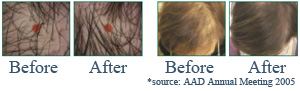
Before and after pictures of nettle extract results

The scientists concluded that the extract of Bohemeria nipononivea they studied could be effective and safe for treating women with female Androgenic Alopecia.

“Extracts can help to some degree,” said Dr. Larry Shapiro, who has hair transplant clinics in Miami and Boca Raton, Florida, “because they may help an underlying condition. But unless the condition is assessed by a specialist and properly diagnosed, herbal extracts may end up making the condition worse.”

Timely Treatment for Spot Baldness is More Effective

Catch balding earlySpot baldness, or alopecia, affects approximately one or two per thousand people, mostly females. The most common type of alopecia results in one or more round spots of lost hair on the scalp, but in rare cases, it can affect the entire scalp or body.

Spot baldness can be caused by a variety of reasons. Alopecia areata is usually caused by T-cell lymphocytes (auto-immune). Several other factors can cause spot baldness such as fungus, or traction alopecia (constant pulling).

When people seek topical drug treatment for alopecia, the best predictor of success is age. According to a study by Pfizer Consumer Healthcare, the fewer number of years a man had been experiencing alopecia, the more effective topical minoxidil therapy was.

Women in the study showed no correlation between the effect of the therapy and duration of balding. This may be because it is harder to identify when alopecia starts in women. Hair loss tends to be more spread out throughout the scalp in ladies with this condition, and the thinning of the hair may not be noticed for some years. Therefore, women in the study may not have been able to accurately indicate the date their alopecia started.

Men with alopecia have more noticeable vertex (spot) balding. It is clearly recognizable by a man or his family members. The spot grows larger over time. The larger the vertext balding in men when they started the minoxidil treatment, the less effective the treatment.

Therefore, seeking treatment as soon as hair loss or hair thinning is noticed can dramatically improve results.

Dr. Larry Shapiro is the founder of Dr. Shapiro’s Hair Institute. “In my hair transplant Boca clinic and hair transplant Miami clinic, we can treat these patients with an injection of a mild steroid solution. Many other patients in our hair transplant south Florida clinics have spot baldness due to hereditary factors and only a transplant can successfully replace the hair,” he said.

Source: Pfizer Consumer Healthcare paper