Female Pattern Hair Loss and Hair Transplants

Women experience hair loss differently than men. Male pattern hair loss means losing hair in the front and top of the head, leaving a “wreath” of hair around the head. Female pattern hair loss typically involves losing hair all over the head, or having bald patches in various places. Men can experience female pattern hair loss, and vice versa, but this is less common.

Females can lose hair for a wide variety of reasons. It is normal for women to lose excess hair after having a baby, for example.

Fungal infections are another cause of hair loss in women, treatable with medicine.

Traction alopecia is hair damage caused by pulling the hair in a tight style, such as a bun or braids. Changing the hair style and brushing with a wide tooth comb can halt this condition.

Female hair loss can also be caused by thyroid problems, liver problems, cancer, or excess stress. Hair loss can be a symptom of a serious underlying condition and therefore requires an examination by a doctor.

Androgenic alopecia is hair loss caused by excess levels of the hormone androgen. As a male hormone, androgen can create masculine hair on the body, and it can cause the hair on the top of a woman’s head to become thin and balding. If any underlying medical conditions or hormone levels cannot be corrected, then cosmetic options may be offered. These include laser therapy, for removal of unwanted hair, and hair transplantation, for moving healthy hair follicles to bald or thinning areas.

Women experiencing hair loss usually become extremely self-conscious and worried. Women often consult their hair stylist before consulting a doctor. However, a consultation with a physician will help determine the cause of the hair loss and rule out any serious problems. Additionally, many causes of female pattern hair loss can be addressed.
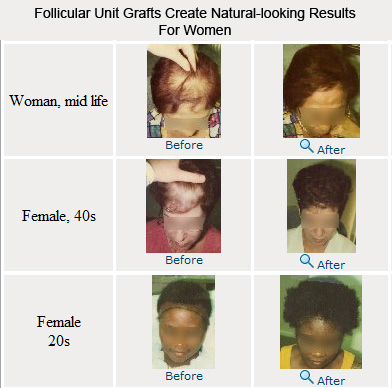
Follicular unit grafts create natural-looking results for women
If cosmetic options are offered, hair transplantation may be considered. Hair follicles from a “donor” site on the individual’s head are transplanted to the bald or thinning spots. Whereas male pattern balding leaves a healthy “wreath” of hair as a donor site, female pattern balding presents more of challenge to find donor hair on the scalp. A hair transplant doctor who specializes in hair transplants, and conducts dozens of hair transplant surgeries per month, is the best choice due to the specialist’s level of experience.

Hair transplantation involves local anesthetic. A strip of skin is removed from the scalp in inconspicuous “donor” regions. These areas are repaired with sutures to minimize scarring. The removed hairs are cut short and analyzed under a microscope. Then, follicular units are dissected and the balding area is given local anesthetic. The grafts are placed into small incisions in the balding area.

Approximately 3 – 6 months later, the hair transplant patient grows hair. In 9 – 12 months, full growth takes place. See more pictures and a video about hair transplants for women.

Female pattern balding in women is neither inevitable with age, nor untreatable. Hair stylists can be helpful for cosmetic purposes, but only a doctor can determine the cause and offer medical treatment.

Male Pattern Hair Loss and Hair Transplants

male pattern baldingMen often experience hair loss. Most healthy individuals lose about 150 hairs per day, but balding individuals lose more and start to notice thinning and bald patches.

The most common reasons for male hair loss are: genetics/hormones, an auto-immune disorder, and fungal infections.

As much as 99% of male hair loss is related to genetics. Balding runs in families. It’s called “androgenetic alopecia” or “male-pattern hair loss.” These genes come from both the mother and father.

The adult sons of balding men may notice their own hair loss, sigh, and resign themselves to the fact that their genetics will make them lose hair, too.

So they do nothing. They clean up the hairs that fall out into their bathroom sink every day, and await their fate. The longer they wait to see a dermatologist to truly understand their hair loss, the worse the problem gets.

A trip to the dermatologist will help to rule out an auto-immune disorder called “alopecia areata.” A fungal infection can also cause hair loss and needs specific treatments with medicine.

Look closely at the scalp of a man with male-pattern hair loss and you will notice that the hair loss is at the frontal hair line and on the top of the head. The rest of the scalp, at the back and sides, has plenty of hair.
Genetics have decided to release the hairs on the front and top. However, genetics also pre-programmed the hairs on the back and sides to stay in place. These hair follicles continue to grow hair throughout life. And with male-pattern hair loss, there are plenty of these hairs available.

Follicular unit transplantation utilizes this “donor hair” because it is already genetically resistant to the male-pattern balding. When hair is taken from the back and sides, it can restore natural hairlines that are also genetically resistant to balding.

Under local anesthetic, while the patient is fully awake, long strips of skin are painlessly removed from inconspicuous “donor” areas on the back and sides. Sutures are used to seal these areas with minimal or no visible scarring. Then, the hairs are cut short. Using a microscope, the grafts are analyzed for quality and the follicular units are dissected.

Grafts with just a few follicles are used to create a natural looking hairline. Grafts with 3 or 4 follicles are used further back. “There is an art and a science to making a natural-looking hairline,” said dermatologist and hair transplant doctor Lawrence Shapiro. “At my hair transplant clinics in Boca Raton and Miami Florida, we conduct extra dissection of the fatty tissue around the hair follicles for better results, and we match the natural direction of the original hair follicles.”

The balding recipient site is then numbed using local anesthetic, and small incisions are made. The grafts are packed into these tiny incisions. A recipient area can receive 500 to 4,000 grafts.

In about three to six months, the patient will have new hair growth. Full growth will take place in nine to twelve months.

The grafts will continue to grow and will be unaffected by male pattern baldness. If further male pattern hair loss occurs on the original hair, a follow-up follicular hair transplant can be conducted.

Any man experience hair loss should seek professional medical advice before resigning his scalp to fate.

Current Hair Transplant Surgical Techniques Are Superior to Outdated Punch Grafts

Follicular Unit Grafts are Superior to Older Punch Grafts for Hair Transplants

When you hear the words “hair transplant”, what comes to mind? Islands of big chunky hair plugs dotting a mostly-bald scalp? Good news: Times have changed!

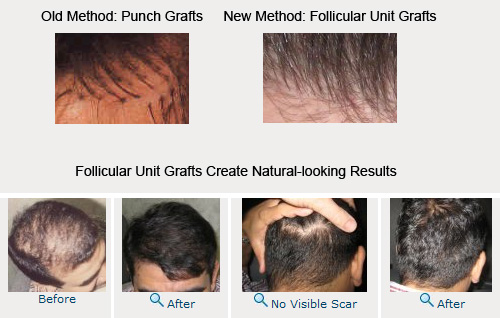
Outdated “punch grafts” have been replaced with “follicular unit grafts.” Follicular unit grafts maintain their existing anatomy. They are transplanted from the sides and back of the scalp because this hair is genetically encoded to grow throughout life.1 So hair restoration surgery utilizes your own genetics to produce success.

Hair from the sides and back of the scalp is growing perpetually, so it is used as a donor region for hair restoration surgery. But what happens to the donor area? With new techniques, the donor area is enclosed and surrounding hair covers the site completely, usually leaving the surgery undetectable even immediately after a procedure.

For most people, this transplanted hair never falls out. Hair transplantation is usually a permanent solution for hair loss and balding.

What does this technique entail? The latest technology is based on specific anatomic units that are called follicular units.

Follicular units are the natural groupings of the hair, the way it normally grows. Follicular units consist of: one to four or rarely five terminal or mature hairs, one or two vellus-fine hairs, a blood vessel and a discrete nerve supply, a sheath of connective tissue, sebaceous glands, and the erector pili, a tiny muscle. This method creates the most undetectable result and makes it easy for the surgeon to following the natural angles of emergence from the scalp. The angles a which hairs exit the skin varies widely. This is important because there is variance of these angles depending on a particular area of the scalp.

More blood and oxygen circulate to the hairs in the graft, which results in improved survival over older methods. The incision is smaller; thus, it heals more quickly and establishes a nourishing local blood supply to the grafts.The older “plug” techniques created scarring and impaired the flow of blood under the scalp. Follicular unit grafts utilize very tiny slits; therefore, minimal tissue is subjected to scarring, and other complications are rare. Dr. Larry Shapiro, with hair transplant Miami and hair transplant Boca Raton clinics, is one of the few pioneers of the ultra refined follicular units, which involves further dissection of the fatty tissue around the hair follicles for very natural results.

How long does this procedure take? Many short sessions can impact the patient’s schedule.Dr. Larry Shapiro, a dermatologist and hair transplant surgeon, typically recommends starting with 3- to 5-hour follicle unit transplant session. “We cannot guarantee one sitting, but many patients are satisfied with one sitting, which typically creates a natural, undetectable result,” said Dr. Shapiro. With 20 years of experience, he has performed more than 11,000 hair transplant surgeries in South Florida. “Even with further hair loss, this transplant can stand on its own.” Additional sittings are needed if a patient loses more existing hair and wants to replace it, or wants additional density. Patients may also want to change or lower a hairline. “We have an extremely efficient and expedient process,” said Dr. Shapiro.

This technique can match the orientation of surrounding hair follicles. When follicular unit grafts are performed correctly, the cosmetic results of contemporary hair transplantation are virtually undetectable in women and men.2 Other solutions may slow hair loss, however, this is a permanent solution. Patients and physicians alike are pleased with the results of contemporary hair transplantation, and physicians can now recommend the procedure without reservation.

If you have already had hairline loss, hair transplants are a safe and permanent solution for restoring natural hairlines. See more photos of the results of this surgery.

Hair Loss from Hair Dye: Is the Damage Done?

Dying hair can be damagingMany people, especially women, use permanent hair dye for cosmetic purposes. There are many motivations: reducing the appearance of aging; making gray fuller and softer; fashion; enhancing an existing color; expressing one’s personality.

Both doctors and cosmetologists are interested in the effect of these dyes and chemicals on the hair shaft. Can they harm the hair shaft or cause hair loss? Or are they completely safe?

Frequent users of permanent hair dyes have noted that their hair can become damaged and dry, and even fall out. Hair care products that claim to help repair this damage are widely available.

One study1 examined the lipid (oil) changes in the hair cuticle after permanent hair dye was applied. Using an electron microscope, the researchers found that the cuticle (the part of the hair that attaches to the scalp) at first became swollen when exposed to the dye. When the swelling started to go down, the cuticles began to degrade. The most severe hair samples had holes in the endocuticle, swelling in the lipid layer and even breakage. Over the course of a week, the amount of damage was lessened.

Once the hair has been noticeably damaged, cutting the hair shorter can remove damaged sections and reduce the weight of the hair, so there is less tension and breakage. Taking a break from hair dyes or switching to temporary, natural dyes can also help. Additionally, a professional hair stylist can offer advice.

If hair loss continues after quitting the dyes, a dermatologist should be consulted in case the hair loss has another cause.

Source: 1. The Damage and Restoration of Integral Hair Lipid Following Treatment with Hair Dye

Hirsutism – Masculine Hair on Women – Requires Diagnosis Before Treatment

Hirsutism is a concern for many womenHirsutism is when females grow noticeable hair in places that are typical to men, such as on the face or on the chest. Hirsutism is not a disease, but it is a symptom of an underlying condition.

Women naturally have low levels of androgens, such as testosterone. Hirsutism can be caused by increased levels of androgens. This could signal underlying hyperandrogentic-related conditions. Polycystic ovary syndrome (PCOS) may be the underlying cause in most cases of hyperandrogenism.1

If hirsurism is accompanied by hair loss and acne, the list of possible causes grows to include POCS or one of these rare conditions: late onset congenital adrenal hyperplasia (a problem with the adrenal glands) or an androgen producing tumor from the ovary or adrenal gland.1

Treating the symptoms without a diagnosis can be dangerous. A complete examination from a dermatologist, and possibly from a reproductive endocrinologist, is needed for a diagnosis. “When treating patients with hair loss, I investigate the underlying cause,” said dermatologist Lawrence Shapiro. “Just slapping on a cream is foolhardy. Hair loss or masculine hair on a woman can indicate a serious condition. Even if the condition is not serious, a doctor of dermatology will develop an efficient, rational plan course of treatment.”

Another category of causes of hirsutism is when the hair follicles are oversensitive to male hormones such as testosterone.

Women who are obese tend to become resistant to insulin (Type II diabetes), and are at high risk of developing hirsutism. Hirsutism is a sign of hormone imbalance, possibly due to high circulating levels of insulin in their systems. The theory is that insulin, at sufficiently high levels of concentration, stimulates the ovarian theca cells to produce androgens.2 Larger quantities of male hormones are produced, resulting in masculine hair growth or hirsutism.

Other conditions that may increase a woman’s male hormone levels and result in hirsutism include Cushing’s disease, certain medications, and Stromal Hyperthecosis (in postmenopausal women).

Treatment could include addressing any serious underlying conditions, balancing the hormone levels, and/or offering cosmetic options.

Sources:
1. “Getting to the root: Look below the surface for cause of hyperandrogenic symptoms” by Nancy A. Melville, Dermatology Times, August 2009
2. Wikipedia: Hirsutism