Affordable Hair Transplant

Hair transplant costToday, more than ever, most consumers are looking for an affordable solution to hair loss. Unfortunately, many physicians will try to make you believe that if you are paying more you are getting better results. This is certainly not true in the field of hair transplantation.
Taking the time to research the doctor’s qualifications can help you make an informed decision. The most important factor to a good outcome is the experience of the physician. Find out how many procedures he or she has actually performed and make sure you see a surgical hair transplant during your consultation. An affordable hair transplant should only be performed by a qualified surgeon who has spent many years perfecting his craft.
Many hair restoration clinics will offer flexible payment plans so that you can have your hair now without the stress of coming up with all of the money at once. So don’t be fooled by fancy offices with empty waiting rooms or doctors that will sell you unproven treatments for your hair loss. Experience and an affordable price can go hand in hand providing you with the best solution to your hair loss.

Removal of Transplanted Hair

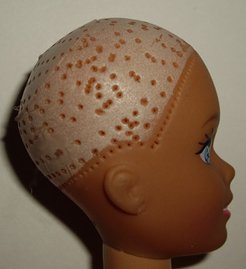
Dolls Head Plugs Many patients that have had a hair tranplant in the late 80’s or before may be interested in hair transplant removal. Large, pluggy grafts or grafts that are placed to far apart do not leave a natural appearance. In this case most people just want them removed. However, a much better solution is to work around these plugs adding smaller grafts to give a softer, more refined appearance.
The first step is to have a qualified physician assess the situation and determine the best course of action. Removal of the grafts will very likely leave scarring and possibly even prohibit new grafts from growing in that area. Some doctors use a punch to remove these plugs but the patient may not be satisfied with the outcome. The removal of the grafts could leave the patient even more unhappy than before.
The best way to approach a hair transplant repair is to fill the area with smaller, more natural grafts that consist of 1 or 2 hairs in around those plugs. This will usually give the patient the natural look they desire as well as added density in that area. By putting these smaller hairs in front of the plugs the eye will be drawn to the natural hairline created by the physician. Luckily, most patients today do not have to worry about pluggy results but the patient must be careful to choose an experienced physician and see the work prior to committing to the procedure.

Facelift, Brow Lift, Rhytidectomy Hair Loss Have Permanent Treatment

Rhytidectomies, including facelifts and brow lifts, can cause hair loss, especially in the hairline in the temple area. Temporary hair loss is common, but the condition can be permanent.

Facelifts involve pulling the skin, cutting excess skin, and resewing it back. The skin is undermined and manipulated during a facelift. This manipulation can traumatize the hair follicles in the area where the procedure was done.

Most of the time, the hair grows back. Sometimes, the hair follicles are so traumatized that they do not grow back. In these cases, hair transplants are usually a viable option.

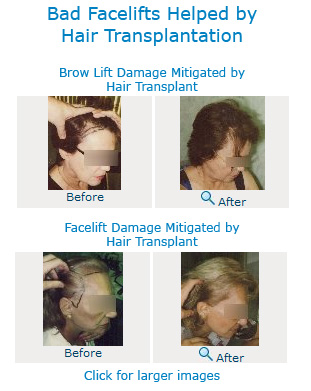
bad facelifts helped by hair transplantationA woman came to Dr. Shapiro’s Hair Institute after a brow lift damaged her hairline. Using follicular unit transplantation, the doctor was able to repair and restore her hairline with completely natural-looking results. A strip of her scalp was removed, and the area was sewn up. The hair follicles were isolated and carefully processed for transplantation in the bald patch. After the procedure, her hair grew back beautifully, giving her the results she wanted.

Another female came to Dr. Shapiro after a facelift damaged her hairline, as well as the area above the ears. Distraught that her rhytidectomy had resulted in hair loss, she sought a hair transplant. The results were virtually undetectable from her original hair line. The hair transplant used her own natural hair from another part of her scalp. She was very pleased with the results of her hair transplant.

Not every dermatologist can achieve these kinds of natural-looking results. Seek a hair transplant doctor who has several decades of experience, and focuses only on hair transplants. With this kind of procedure, performing only one or two hair transplants per week will not allow the doctor to develop the skill level needed for incredible results. Dr. Shapiro, with hair transplant clinics in Boca Raton and Miami, Florida, has over 20 years of experience in hair transplant surgery and can help many women who experience permanent hair loss after facelifts and brow lifts.


Drug Therapy versus Hair Replacement Surgery

The only permanent “cure” for hair loss is hair replacement surgery. Sometimes drug therapy is used in conjunction with surgery, but medications alone will not restore hair to bald areas of the scalp. If drug therapy is the only weapon in your doctor’s arsenal, when drug therapy stops, your hair will begin to fall out again.

The FDA has approved just two medications for hair loss: Rogaine and Propecia.

  • Rogaine is a foam or liquid solution, applied twice daily, that slows the hair-loss process and promotes new hair growth in 30 percent of its users. Rogaine is generally prescribed for those who do not respond to Propecia.
  • Propecia — a pill taken daily that offsets the effects of DHT (dihydrotestosterone). DHT is a hormone that destroys hair follicles in persons who possess it in abundance. Propecia has been shown to stop the hair-loss process in 86 percent of the men who use it.

Unfortunately, side effects for both medications abound.

  • Propecia tablets are dangerous for women. Broken tablets merely touched by pregnant women were found to cause birth defects in male infants.
  • Serious allergic reactions may occur, and
  • The drug may cause problems in sexual functioning.

The cost of treating hair loss with drugs is astronomical over time, hundreds of dollars a month in most cases, a fact that is particularly discouraging if, after such an investment, treatment must be discontinued. Once the drugs stop, hair loss starts again.

By contrast, permanent hair replacement is a happier, healthier, and wealthier solution. Happier because it not only stops hair loss but covers bald spots with natural, permanent hair. Healthier because there are no side effects and you do not need to continue drug therapy for the rest of your life. It is friendlier to the pocketbook as well. In most cases, one or two sessions — generally priced between $2,000 and $6,000 each — will provide you with the long-term, maintenance-free hair replacement you seek.

If you or someone you love suffers from hair loss and you select to go the route of hair transplant surgery, make sure you select a doctor with adequate skill and experience, a doctor versed in the latest methods and practices. Outdated procedures don’t yield good results, causing phenomena like unnatural-looking hairlines and “doll-head hair” (unsightly plugs). Doctors who still perform these procedures may call them by various names that make it sound as if they practice the newer methods.

Buyer beware: a good hair doctor will be performing surgeries every day. Ask for names of former patients and call those people for references. Insist on seeing the procedure performed before you sign up for it. A reputable hair surgeon will be gracious in granting both requests. If a prospective doctor hesitates on either, keep shopping.

Hair replacement surgery can be one of the best things you ever do for yourself. Or it can be a nightmare in the hands of the wrong physician. Do your homework, and be prepared to travel as necessary. The likelihood that a skilled hair transplant surgeon lives down the street from you is very slim.

Female Hair Loss and the Thyroid Gland

Women experiencing hair loss can become extremely self-conscious and worried about their appearance. Women, like men, want healthy hair. Discovering the reasons for female pattern hair loss involves looking at the person’s entire health picture.

Female hair loss usually occurs everywhere on the scalp or in patches at any location on the scalp. This is different from male pattern balding, which affects the front and top of the scalp.

Hormones play a major role in our overall health, including the health of our hair. Some glands work very closely together.

This article focuses primarily on the thyroid gland, which can cause female hair thinning. Thyroid hormones play several important roles in growth, development, and metabolism. The thyroid gland is sensitive to hormones secreted by the pituitary gland. The pituitary gland secretes thyrotropic hormone (affecting the thyroid gland), adrenocorticotropic hormone (affecting the adrenal cortex), and three gonadotropic hormones (affecting the reproductive glands).

In addition your hypothalamus, the brain’s brain secretes hormones that influence the pituitary gland. The hypothalamic hormones are referred to as “releasing hormones” and “inhibiting hormones,” reflecting their influence on anterior pituitary hormones.

The thyroid gland is located on both sides of the trachea. The thyroid is an endocrine gland, which secretes thyroxin, the thyroid hormones (T3 and T4). Thyrosin controls the rate of metabolism. If thyroid function is disturbed, it can affect any of metabolic activities, including hair loss.

Both hypothyroidism (underactive thyroid) and hyperthyroidism (overactive thyroid) can contribute to hair loss in men and women. When the thyroid has either of these conditions, hair follicles remain in the third phase of growth – the dormant phase – for a longer period of time than normal. This leads to stalled hair growth and, eventually, hair loss.

Thyroid disfunction is known as “the great pretender” because there are dozens of diverse symptoms that seem unconnected, and it is hard to pinpoint the problem as the thyroid. Hair loss can be a component of many of these conditions, which may include hormone imbalances, lethargy, dry skin, depression, slow heartbeat, memory distubances, weight gain, anxiety, skin changes, menstrual imbalance and deceleration of metabolic rate, and chronic yeast infection.1

Testosterone in men and women can be converted by an enzyme called 5-alpha reductase to dihydrotestosterone (DHT), which shrinks hair follicles and eventually causes them to disappear. This accelerates hair loss in men and women. Especially in women, a condition known as estrogen dominance can lead to a hypoactive thyroid. When estrogen levels are high, excess estrogen can bind to thyroid receptor hormone sites and slow metabolism by blocking the conversion to T4 to T3, the active form of the hormone. Progesterone cream may be recommended to balance the estrogen/progesterone ratio. The herb Vitex (Chaste Berry) may balance the estrogen/progesterone ratio, but it will take about three menstrual cycles to take effect.

Before proceeding with any treatment, it is important to see a doctor and get blood tests to find out for certain what is causing female hair loss. Hair loss may be a sign of a serious but treatable condition.
 
Depending on the cause of female hair loss, and how the patient responds to treatment, hair transplantation may be a viable option.

Sources:
1. Scheinbaum, Michael Arluck, Getoff, David, Reduce Blood Pressure Naturally (United States of America: Xlibris, 2005), 265-267.