Hair Transplant Worries

Worried about the idea of a hair transplant? Learn the facts.

Have you heard about hair transplants, but worry that there will be problems or side-effects from the hair transplant? A hair transplant need not be a worrisome experience, if you ask these important questions.

Question: Is this a major surgery?

Answer: No. A hair transplant is done on an outpatient basis under local anesthetic. Your scalp is numbed, and you are in a relaxed, reclined position for the hair transplant. A strip of hair-bearing scalp is removed, and the follicular units are graded and separated. Then, these follicular units are transplanted into tiny incisions in the balding areas. You go home the same day and return to most normal activities the next day. Pain is minimal and controlled with medication for a few days.

Question: Will there be clear signs I just had surgery, such as bandages?

Answer: With a hair transplant by a skilled hair transplant surgeon, there will be no bandages or other obvious indications of surgery. The area of the scalp where the strip of donor hair is  removed will be covered by the hair around it. At most clinics, the hair attached to Continue reading

Is Scalp Reduction Surgery Needed With a Follicular Unit Transplant?

Scalp reduction is a procedure in which bald scalp is removed, in order to bring the edges of scalp containing hair-bearing closer together. With the current sophistication of Follicular Unit Transplants, is scalp reduction necessary?

Scalp reduction was introduced in the 1980’s when hair transplants looked like doll’s hair (plugs). Scalp reduction was popular with people who had male pattern balding at the front and top of the head. The thinking was similar to how you might repair a bad stain on a flexible piece of fabric: cut out the stain and sew it back together. In the same way, after scalp reduction, the bald patch was smaller or non-existent, with a scar along the top of the head.

However, there are several problems with scalp reduction surgery.

Continue reading

Hair Weave Vs. Hair Transplant for Hair Loss

hair loss

Thinking about treatments for hair loss? Compare a hair weave to a hair transplant

The roster of treatments for hair loss includes hair weaves and hair transplants. What is the difference? And what are the pros and cons of each hair loss option?

A hair weave involves using your own hair, or combining it with synthetic hair or human hair, to conceal hair loss in both men and women. The hair is painstakingly woven, or hand-knotted, in specific patterns to provide hair coverage.

A hair transplant means that your own hair is transplanted from one part of the scalp to another. During a follicular unit transplant, the scalp is numbed and a strip of scalp containing long-lasting hairs is removed, dissected into small follicular units of 1-5 hairs, and skillfully inserted into the balding areas.

Natural Hair: Hair weaves are attached to your own hair; natural hair can be purchased to be woven in, but often, synthetic hair used because synthetic hair is easier to attach and keeps its curls longer. Hair transplants use 100% natural hair, and this is your own hair, moved from one part of the scalp to fill in the balding areas.

Continue reading

The Hair Growth Cycle and Hair Loss

Hair follicles normally go through a growth cycle of three stages: anagen (growth) phase; catagen (transition) phase; and telogen (dormant) phase.

The anagen phase normally lasts several years, and is the time when the follicle produces a hair. The hair continues to grow until some unknown signal causes the follicle to enter the catagen phase.

The catagen phase lasts a few weeks and marks the end of the growth of a hair. The follicle begins to shrink. At the end of the catagen phase, the hair detaches from the follicle and may easily fall out, and the follicle becomes dormant.

The telogen phase is when the follicle is dormant. It lasts about three months.  At the end of the telogen phase, Continue reading

Hairline Refinement with Follicular Unit Micrografting

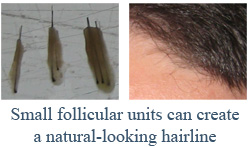
Small follicular units can create a natural-looking hairline“The cover sells the book.” In the same way, a natural-looking hairline is the measure of a successful hair transplant. No one should have artificial-looking “plugs” anymore. With the development and refinement of follicular unit micrografting by hair transplant doctors, a natural-looking hairline is possible for patients with “plugs” seeking hairline refinement (also known as hairline correction).

In the past, “punch” style hair transplants often looked like doll’s hair, creating an artificial appearance. Scalp from a donor site on the patient’s scalp was removed and transplanted. A single incision held 5-10 hairs. This type of hair transplant was often noticeable and unnatural-looking. Some patients who received these transplants are now seeking Continue reading